Lighting and visibility laws for agricultural vehicles
What you need to know
This page offers information on the lighting requirements and exemptions for agricultural vehicles.
General Rules
Agricultural tractors and self-propelled agricultural equipment
These must be equipped with full lighting systems i.e., side lamps, head lamps, rear lamps, stop lamps, direction indicators, amber beacons, and number plate lighting at all times and not just during lighting up hours.
Agricultural trailers and interchangeable towed equipment
These must be equipped with side lamps, rear lamps, stop lamps, indicators, and number plate lighting. They must also be fitted with a marker lamp on their right-hand side if the overall length of the combination (when coupled to an agricultural tractor) is more than 10 m.
Agricultural trailers with a DGVW over 3,500 kg
These must be fitted with reflective rear markings. If these trailers form part of a combination of vehicles over 10 metres long, they must also have reflective side markings. A rear ‘LONG VEHICLE’ marking must be fitted to a combination of vehicles over 13 m. long.
The reflective and ‘LONG VEHICLE’ marking requirements do not apply to pieces of interchangeable towed equipment that can carry more than three times their own unladen weight, e.g., slurry tankers, fertiliser or manure spreaders, grain chaser bins, etc.
Work or ploughing lamps
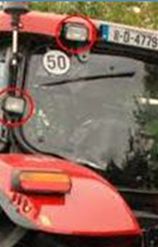
Work or ploughing lamps are fitted to the back of agricultural tractors and self-propelled machinery to give extra visibility when working on the farm. They may be used in your own private area i.e. field, farmyard etc. but it is illegal to use them on the public road so they must be switched off beforehand.
Further information on lighting and visibility
For further details Download and read our Revised Standards for Agricultural Vehicles
Frequently asked questions
Yes. Vintage tractors or machinery, i.e., manufactured or first registered 30 years ago are exempt from having to be equipped with a full lighting system, e.g., side lamps, head lamps, rear lamps, stop lamps, direction indicators and number plate lighting provided they are being used during daylight hours only. This also applies to the trailers being towed by them.
Daylight hours means any time outside ‘lighting-up’ hours. 'Lighting up’ hours is a half hour after sunset until a half hour before sunrise the next day.
Yes. Since 01 January 2016, all tractors are required to be fitted with a flashing amber beacon and have it switched on when in use. Vintage vehicles do not require beacons if they are only taking part in vintage rallies or being used for display purposes.
No. You must keep the lighting and reflectors fitted to your existing vehicles well maintained in a clean and efficient condition so they can be used at any time.
Yes. However, such equipment will only need lights if when attached to a tractor or self-propelled agricultural machine it blocks the lighting and reflectors fitted to the front or rear of the tractor or self-propelled agricultural machine itself.
Yes, unless they are vintage.
Yes.
You should contact the original manufacturer or authorised Irish distributor. If the original manufacturer is no longer in business, you could contact an alternative manufacturer of similar equipment. They may be able to examine the vehicle and advise what work is required if any to achieve compliance.
Road traffic regulations ban the use of white lights to the rear of any vehicle in a public place. In times of darkness, it can confuse motorists into thinking that a vehicle is approaching. Only red and amber lighting should appear on the back of a vehicle, not white lamps. In addition, these work lamps are highly powered which can cause other road users to be temporarily blinded which is a serious road safety concern.
For further information on the correct operation of agricultural machinery including lighting, Download and read our Revised Standards for Agricultural Vehicles.
You can also view our videos which visually demonstrate these rules.