
Motorcycle Safety Campaign
Motorcycle Safety TV-Led Campaign
Motorcyclists are among the most vulnerable people using Irish roads. This campaign encourages motorists and motorcyclists to take simple, practical actions that can help reduce the risk of a collision.
The campaign has been informed by collision and serious injury data, research with road users, and extensive consultation with motorcycle safety specialists.
A data-led approach
RSA research shows that junctions are a significant risk area for motorcyclists.
Between 2021 and 2025, 954 motorcyclists, including pillion passengers, were recorded by An Garda Síochána as seriously injured following road traffic collisions. Of these serious injuries:
- 38% occurred at a junction.
- 66% involved more than one vehicle.
- In multi-vehicle collisions, the other vehicle involved was most commonly a car.
- Failure to observe was the action most frequently noted for both the other driver and the motorcyclist.
Earlier RSA research covering the period 2020 to 2024 found that, where a motorcyclist was seriously injured at a junction, the junction was most likely to have been a T-junction. Of the 316 motorcyclists seriously injured at junctions during that period, 173, or 55%, were injured at a T-junction.
This evidence helped identify the moment when a motorist turns across the path of an approaching motorcycle as an important area of risk. The latest research also found that turning right was the most frequently recorded movement by the other vehicle in multi-vehicle serious injury collisions involving a motorcyclist.
The research highlights a simple but important issue: a motorist may look at the road without fully registering the approaching motorcyclist.
Motorcycles are smaller than other vehicles and may be less expected on the road. Their speed and distance can also be more difficult to judge. At a T-junction, a quick or automatic glance may not be enough.
Figures from 2022 onwards are provisional and subject to change.
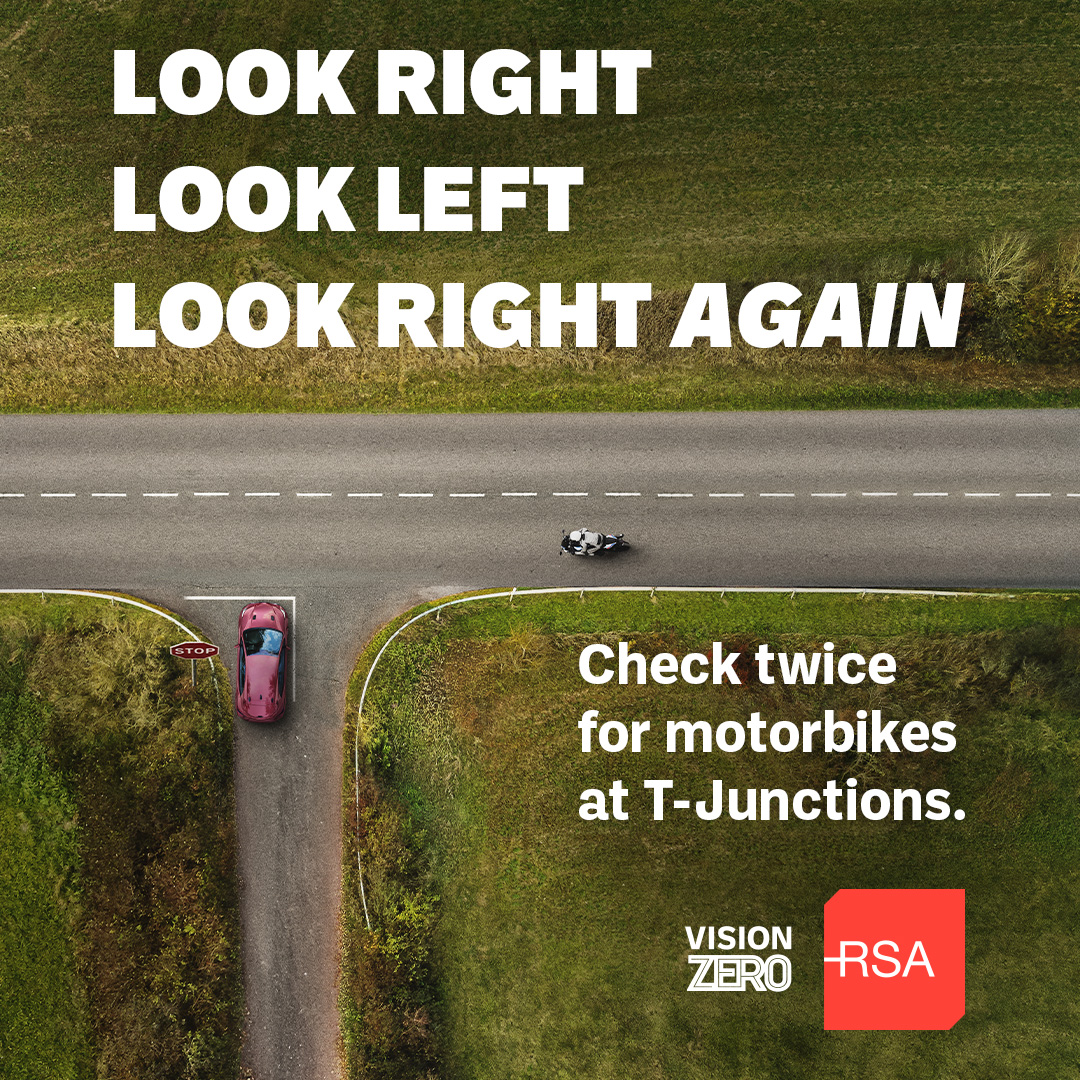
Two connected parts of the campaign
The campaign has two clearly defined audiences, with each having an important role to play in reducing risk.
The primary campaign: motorists
The TV-led primary campaign is aimed at motorists of all ages and focuses specifically on driver behaviour at T-junctions.
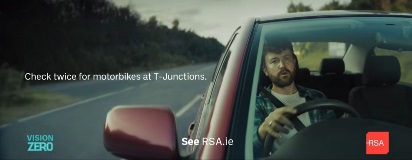
It asks drivers to look carefully for motorcyclists before moving out from a T-junction. The required behaviour is simple:
Look right. Look left. Look right again.
The campaign encourages motorists to make this second look a normal and necessary part of checking the road at a T-junction, rather than relying on a quick or automatic glance.
The aim is to help drivers see the approaching motorcyclist before they move.
The primary message will be supported across television, VOD, outdoor advertising, radio, digital audio and social media.
The story behind the television advertisement
The television advertisement uses the setting of a film production to demonstrate how taking a second look can help prevent a collision at a T-junction.
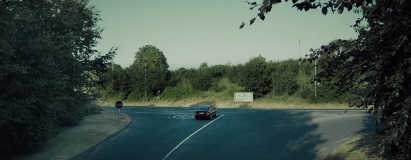
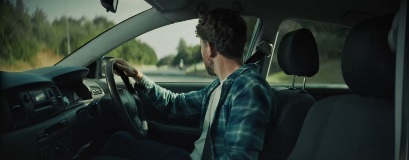
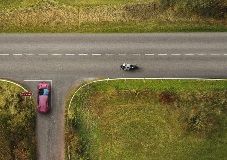
In the first take, a motorist arrives at a T-junction and prepares to turn right. He looks, but does not properly see the approaching motorcyclist. The vehicle moves into the motorcyclist’s path and a collision occurs.
The motorist is visibly shaken by what has happened. He knows the collision should not have occurred and is confronted with the seriousness of the possible consequences.
A voice then calls, “Cut”, revealing that the scene is being filmed. Because it is a film set, the motorist is given a second chance to do things differently.
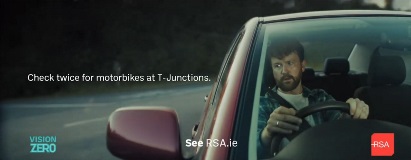
The scene is reset, and the motorist returns to the same T-junction. This time, he looks right, left and right again. He sees the approaching motorcyclist, waits and allows the rider to pass safely.
The contrast between the two outcomes delivers the central message of the advertisement. On a film set, a scene can be repeated, and a mistake can be corrected. In real life, there may be no opportunity to try again.
The advertisement makes one clear point:
There are no second takes in life.
The film shows how taking a little more time and checking properly at a T-junction can change the outcome.
It is not intended to place blame on motorists or motorcyclists. Instead, it shows how easily a critical moment can be missed and how a proper second look can help prevent a collision.
The secondary campaign: motorcyclists
The secondary campaign speaks directly to motorcyclists of all ages and focuses on rider behaviour when approaching or travelling through junctions.
It recognises that other road users may not always see a motorcycle, anticipate its movement or accurately judge how quickly it is approaching.
The campaign therefore gives riders four practical actions that can help them manage risk at every junction.
These actions are summarised by the acronym VOWS:
V: Visibility
Position yourself so that you can see and be seen. Wear visible protective gear and use dipped headlights.
O: Overtaking
Avoid overtaking when approaching or travelling through a junction. Another vehicle may turn across your path without warning.
W: Watching
Observe your surroundings and anticipate what other road users may do. Watch for vehicles emerging, turning or changing position.
S: Speed
Manage your speed as you approach every junction. Give yourself the time and space needed to react safely.
At every junction, remember your VOWS.
The secondary campaign will be delivered through targeted digital audio, social media and motorcycle community channels.
It has been designed to complement the primary campaign, rather than shift responsibility onto motorcyclists.
The primary campaign asks motorists to take a proper second look for motorcyclists at T-junctions. The secondary campaign gives motorcyclists practical actions to help them manage risk at junctions more generally.
Developed with motorcycle safety specialists
Specialist input has been central to the development of this campaign.
The RSA completed more than 24 hours of consultation with people who have direct experience of motorcycle riding, training and road safety.
Contributors included:
- Initial Basic Training instructors.
- Garda BikeSafe instructors.
- The Defence Forces Transport and Vehicle Maintenance School.
- Irish Motorcycle Association representatives.
- Experienced motorcyclists and motorcycle safety commentators.
Their advice helped ensure that the campaign reflects real riding conditions and that its messages are practical, credible and respectful of the motorcycle community.
We are very grateful to all the instructors, riders, organisations and commentators who generously shared their knowledge and experience and helped shape the campaign.
One shared safety outcome
Motorists and motorcyclists have different actions to take, but both parts of the campaign support the same shared objective: helping road users see one another, reducing missed motorcyclists and preventing avoidable collisions.
For motorists at T-junctions:
Look right. Look left. Look right again. To make sure you see the motorcyclist.
For motorcyclists at junctions:
Remember your VOWS
Motorcycle Safety Campaign 40 Second Irish
/270x201.jpg?sfvrsn=8a9376f2_1)


/drink-driving-ooh-select-1.jpg?sfvrsn=50c99bd8_1)

/rsa-speeding-web-banners-384x207.jpg?sfvrsn=60a6a2d2_3)